
Becoming a Financial Controller often changes your relationship with the numbers. Rather than focusing only on preparing or reviewing financial information, you may become accountable for the processes, controls and people that make that information dependable.
The role can include leading the reporting cycle, coordinating an audit, strengthening balance-sheet controls and helping senior colleagues understand the financial consequences of important decisions. Yet its scope differs considerably between employers. Some positions remain centred on technical accounting and governance, while others extend into forecasting, cash management, systems development, commercial planning and team leadership.
Changes to UK corporate governance make this wider responsibility particularly relevant. Revised Provision 29 of the UK Corporate Governance Code took effect on 1 January 2026. It requires relevant companies to explain how their boards monitor and review material financial, operational, reporting and compliance controls, and to provide a declaration about their effectiveness.1
Not every Financial Controller will work for an organisation covered by the Code, but the change reflects the wider importance of robust controls, clear evidence and accountability.
As you consider your next move, look beyond the title. Ask what you would genuinely own, whether you would have the resources and authority to improve the finance function, and how the experience would support your longer-term ambitions. A valuable opportunity should offer more than additional responsibility. It should give you meaningful ownership, appropriate support and room to grow.
Are Financial Controllers in demand?
A Financial Controller is often responsible for the integrity and reliability of an organisation’s financial information. The precise remit differs between employers, but it can include:
- Statutory and management reporting
- Month-end and year-end close
- Internal controls and financial governance
- Audit and regulatory requirements
- Cash flow and working-capital management
- Budgeting and forecasting
- Tax and treasury coordination
- Finance systems and process improvement
- Leadership and development of the finance team
Senior colleagues may rely on the Financial Controller not only to confirm that the figures are accurate, but also to explain significant movements, identify risks and clarify the financial implications of different decisions.
This contribution is particularly relevant in an uneven economic environment. In September 2026, the Bank of England reported improved output and confidence in some sectors, alongside continuing areas of weakness. Investment intentions had improved slightly, employment intentions were broadly flat and the average reported pay settlement for 2026 was around 3.6%.2
For your career, this can place greater emphasis on combining control with context. Producing dependable accounts remains central. Being able to explain what the figures mean for cash, margins, investment and future performance can broaden your contribution further.
How is the Financial Controller role changing?
Financial control has traditionally centred on reliable historical reporting. That responsibility is not disappearing, but finance teams are also being asked to provide timelier insight.
Research from ACCA and CA ANZ, based on a global survey of 1,600 finance professionals, describes finance moving from a retrospective reporting function towards a provider of trusted, organisation-wide insight. The research identifies real-time operational data, data quality and analytical capability as important parts of this change.3
For a Financial Controller, this does not mean leaving reporting and governance behind. It means creating sufficiently reliable data, controls and processes for the organisation to make decisions with confidence.
Your career may therefore benefit from experience such as:
- Improving the speed and quality of the close
- Strengthening forecasting inputs
- Developing more useful management information
- Connecting operational and financial data
- Supporting finance-system implementation
- Improving the control environment
- Explaining risk and performance to non-finance colleagues
A strong progression story is rarely about completing more tasks. It shows how better controls, clearer information or improved processes helped colleagues reach a better-informed decision.
Which industries are hiring Financial Controllers?
Financial Controllers work across almost every part of the economy. The right sector will depend on the financial complexity you enjoy and the experience you want to build next.
What is it like to be a Financial Controller in Financial services?
Banks, insurers, wealth managers and specialist finance businesses can offer exposure to regulation, risk, capital, governance and detailed reporting requirements.
A joint Bank of England and Financial Conduct Authority survey found that 75% of participating financial services firms were already using AI, while a further 10% planned to use it within three years. Firms also identified data privacy, quality, security and bias among the principal risks associated with its use.4
This environment may suit you if you value structured control frameworks and want to develop your experience of governance, regulatory reporting or responsible technology adoption.
What is it like to be a Financial Controller in Technology businesses?
Technology businesses can offer experience of growth, recurring revenue, international operations and changing commercial models.
A Financial Controller may help develop the infrastructure needed to support that growth. The work could include revenue recognition, cash management, audit preparation, systems integration and the development of more scalable finance processes.
This environment may appeal if you enjoy improvement work and feel comfortable balancing commercial pace with appropriate financial discipline. When assessing an opportunity, look closely at the maturity of the finance function, the quality of its systems and how clearly the organisation has defined the role.
What is it like to be a Financial Controller in Manufacturing and engineering?
Manufacturing and engineering can bring you particularly close to the operational factors behind financial performance. Inventory, production costs, margins, procurement, capacity, capital expenditure and supply chains may all form part of your remit.
Make UK reported in June 2026 that output and orders remained positive, while rising operating costs were affecting competitiveness, profitability and investment decisions.5
For your career, this environment can provide valuable experience of costing, inventory control, operational reporting, capital expenditure and working-capital management.
What is it like to be a Financial Controller in Healthcare and the NHS?
Healthcare finance combines financial governance with service planning, resource allocation and public accountability.
From April 2026, NHS England’s updated finance rules require integrated care boards and NHS trusts to deliver a breakeven revenue position as individual organisations. The accompanying framework places emphasis on organisational financial performance, productivity and variance against plan.6
A Financial Controller role in this environment may strengthen your experience of governance, planning and communicating financial information across complex stakeholder groups.
What is it like to be a Financial Controller in Renewable energy and infrastructure?
Renewable energy and infrastructure organisations can provide experience of long-term investment, major projects and complex financial planning.
Depending on the organisation, you may gain exposure to:
- Capital expenditure
- Investment appraisal
- Project accounting
- Long-term cash-flow forecasting
- Contract reporting
- Risk management
- Project governance
When considering an opportunity, establish whether the role provides responsibility for individual projects, portfolio reporting or the broader financial control environment.
How much does a Financial Controller earn?
Salary is likely to be an important consideration when you are assessing your current position or comparing opportunities.
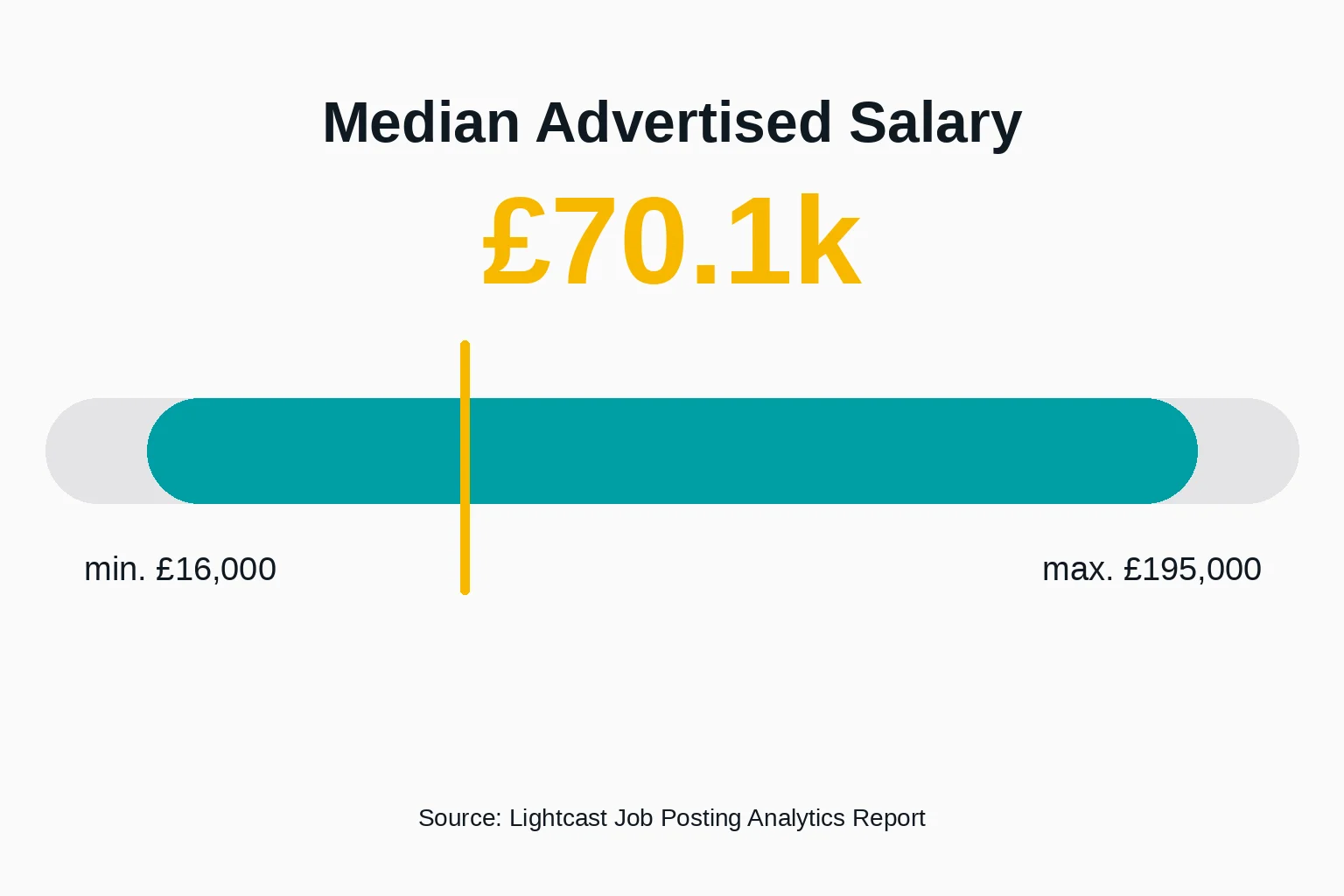
According to the supplied Lightcast Job Posting Analytics Report,7 the median advertised Financial Controller salary was £70,080.
Salary information was available for 3,845 of 8,282 matching job postings, giving salary visibility for 46% of the vacancies analysed.
Among the postings that disclosed pay:
- 55% advertised £70,000 or more
- 33% advertised at least £77,000
- 21% advertised £84,000 or more
- 12% advertised at least £91,000
- 9% fell within the highest band of £98,000 to £195,000
Just over half of the advertised salaries, 53%, were between £56,000 and £76,999, indicating a notable concentration of opportunities around the median. At the lower end, 14% advertised salaries below £56,000.
The overall range extended from £16,000 to £195,000. This is likely to include roles with significantly different levels of seniority and responsibility. However, the supplied data does not isolate the effects of location, sector, employer size or organisational complexity, so it cannot show exactly why an individual salary sits within a particular band.
The £70,080 median offers a useful point of reference rather than a definitive valuation of your experience. A position involving group reporting, international entities, transformation or substantial team leadership may carry different expectations from a more narrowly defined Financial Controller role.
There is also a significant limitation to keep in mind. As 54% of matching job postings did not include salary information, the figures represent salary-disclosing vacancies rather than the whole UK Financial Controller market.
What should Financial Controllers consider when comparing salary, benefits and job opportunities?
For a Financial Controller, the value of an opportunity can also depend on whether the organisation gives you the resources and authority to meet its expectations. A broad remit may look attractive, but it is worth understanding the systems, team capacity and senior support behind it.
Consider how the finance function operates during month-end, year-end and audit periods. Ask whether recurring pressure reflects a genuinely complex role or unresolved issues such as manual processes, unclear ownership or limited resource.
It can also be helpful to explore:
- The size, experience and stability of the finance team
- Whether key processes are automated or heavily manual
- The condition of the control environment
- The quality of financial and operational data
- Expectations around the close, audit and reporting deadlines
- Whether you would have authority to improve processes
- The level of support available from senior leadership
- Opportunities to develop towards Head of Finance or Finance Director responsibilities
These factors may not appear in the headline package, but they can shape your workload, development and ability to make a meaningful contribution. A strong opportunity should not simply give you greater accountability. It should also provide a realistic platform from which to succeed.
ICAEW’s career resources support looking beyond remuneration when assessing progression. Its Financial Controller guidance highlights areas including financial governance, commercial oversight, business partnering, communication, stakeholder engagement, digital transformation and team development.8
Which skills are most valuable for Financial Controllers?
The Financial Controller role requires more than technical accounting knowledge. A combination of financial expertise, commercial understanding and strong communication skills is key to success.
What technical accounting and financial control skills do Financial Controllers need?
Strong reporting, audit, financial control and accounting standards knowledge give you credibility. Depending on the role, experience of UK GAAP, IFRS, consolidation, tax, treasury or regulatory reporting may also be relevant.
Why is commercial understanding important for a Financial Controller?
Understanding how the organisation generates revenue, manages costs and uses cash helps you put the accounts into context. It also enables you to distinguish between an isolated reporting issue and a wider operational concern.
What data analysis and visualisation skills should a Financial Controller have?
Data skills can help you identify patterns, explain variances and communicate financial performance clearly. Useful experience might include forecasting, scenario modelling, dashboard reporting and working with operational data.
What communication and leadership skills does a Financial Controller need?
Financial Controllers often manage competing deadlines, develop team members and explain technical matters to people without an accounting background.
ICAEW identifies influence, relationship-building, strategic thinking and commercial acumen as important capabilities for finance professionals working closely with the wider business.9
What digital and AI skills should a Financial Controller have?
You do not need to build AI systems yourself. It is increasingly useful to understand where analytics and automation can support reconciliations, reporting and forecasting, and where human review remains necessary.
ACCA and CA ANZ identify data quality, analytical capability, integration and responsible governance as important foundations for AI-enabled finance. They also highlight critical thinking, sceptical validation and contextual storytelling as safeguards against excessive reliance on automated outputs.3
How can Financial Controllers strengthen their value and progress their careers?
Financial Controllers can progress their careers by demonstrating commercial impact, leadership, change management and technology skills, alongside strong technical accounting expertise.
1. Evidence improvements, not only responsibilities
Explain how you shortened the close, strengthened a control, improved audit readiness or increased the reliability of reporting.
2. Build your commercial understanding
Connect accounting outcomes with revenue, customers, margins, cash and operations. This helps colleagues understand why a financial issue matters.
3. Gain experience of change
Systems implementations, acquisitions, integrations and control-remediation projects can broaden your experience beyond established reporting cycles.
4. Make your leadership visible
Show how you have developed team members, improved resilience, allocated work and maintained standards when deadlines were particularly demanding.
5. Strengthen your data and technology confidence
Focus on tools that improve the quality, speed or accessibility of financial information. Learn enough about AI to assess outputs, challenge assumptions and recognise potential control concerns.
What career mistakes can limit a Financial Controllers progression
Career progression is not always about correcting a weakness. Sometimes it involves making your existing contribution more visible or broadening the experience around it.
A few habits are worth reconsidering:
- Remaining focused exclusively on producing the accounts
- Solving recurring problems without addressing their underlying causes
- Keeping technical knowledge within the finance team
- Avoiding systems, automation or transformation projects
- Taking on more work without developing the people around you
- Focusing on title and salary without examining the role’s scope
- Waiting for strategic exposure rather than seeking relevant projects
None of these habits is permanent. Improving a recurring process, becoming more involved in forecasting or working more closely with an operational team can begin to add a new dimension to your experience.
How will AI and automation affect Financial Controller jobs?
AI and automation can support transaction processing, reconciliations, data analysis, document review and management reporting. They may reduce some repetitive work, but they also create questions about data quality, controls, explainability and accountability.
ACCA and CA ANZ report that AI can improve productivity and create capacity for more strategic activity, while concerns remain around reliability, trustworthiness and explainability. Their research also argues that finance’s governance expertise places the function in a strong position to support responsible AI adoption.3
For Financial Controllers, this points towards a balanced role. You may use technology to improve efficiency while retaining responsibility for the integrity of the process and the credibility of the output.
Your value may increasingly lie in understanding:
- Whether the underlying data is reliable
- Whether appropriate controls remain in place
- When an automated output needs further investigation
- How the result should be interpreted
- Who remains accountable for the final decision
Technology can produce an answer quickly. The Financial Controller still needs to determine whether that answer is dependable and appropriate for the organisation.
What should Financial Controllers and hiring managers know about the role in 2026
- Technical accounting and financial control remain central to the role.
- Commercial understanding can help you explain the wider significance of financial results.
- Communication, leadership and systems experience may broaden your career options.
- Total reward, role scope, team resources and development should be considered alongside base salary.
- AI and automation increase the importance of governance, validation and professional judgement.
- A valuable next move is often one that gives you stronger evidence of leadership, improvement or wider business influence.
Looking for your next Financial Controller role?
If you are beginning to consider what comes next, Tate can help you explore current Financial Controller and finance opportunities and identify positions that support your priorities.
Browse our latest finance jobs or register with Tate’s talent network and tell us what your ideal next role looks like. We'll keep you connected to opportunities that match your ambitions and help you get ahead when the right role becomes available.
You do not need to be ready to move immediately. Sometimes the most useful first step is understanding what your experience is worth, which capabilities you want to develop and what kind of Financial Controller position could take your career forward.
References
- Financial Reporting Council. Provision 29: Preparing to report. Available at: https://www.frc.org.uk/docs/9097/html/
- Bank of England. Agents’ summary of business conditions: September 2026. Available at: https://www.bankofengland.co.uk/agents-summary/2026/september-2026
- ACCA and CA ANZ (2026). Bridging skills and data gaps for AI-enabled finance. Available at: https://www.accaglobal.com/policy-and-insights/reports/2026/enabling-finance-insight.html
- Bank of England (2024). Artificial intelligence in UK financial services. Available at: https://www.bankofengland.co.uk/report/2024/artificial-intelligence-in-uk-financial-services-2024
- Make UK. Manufacturing Outlook 2026 Q2. Available at: https://www.makeuk.org/insights/reports/manufacturing-outlook-2026-q2
- NHS England. NHS finance business rules from 2026/27: guidance for integrated care boards and NHS trusts. Available at: https://www.england.nhs.uk/long-read/nhs-finance-business-rules-from-2026-27-guidance-for-integrated-care-boards-and-nhs-trusts/
- Lightcast. Job Posting Analytics Report
- ICAEW. How to land your first Financial Controller role. Available at: https://events.icaew.com/pd/32958
- ICAEW (2025). Finance business partnering: five skills you need. Available at: https://devmaster.icaew.com/insights/viewpoints-on-the-news/2025/feb-2025/finance-business-partnering-five-skills-you-need