
For many finance professionals, the Finance Business Partner role represents an important shift in what a finance career can look like. It is not simply about producing accurate numbers. It is about understanding what those numbers mean, asking useful questions and helping colleagues make better-informed decisions.
That distinction matters as organisations respond to changing costs, investment pressures, new technology and more demanding expectations around financial performance.
The wider UK labour market is currently more measured than it was a few years ago. ONS estimates showed 712,000 vacancies across the UK in April to June 2026, down 2.5% from a year earlier, with 2.5 unemployed people per vacancy in March to May.1
For Finance Business Partners, however, the picture is more nuanced. The role sits at the intersection of financial analysis, commercial decision-making and stakeholder management, all of which remain relevant as businesses look carefully at investment, productivity and performance.
So, if you are considering your next career move, what does the current evidence mean for you?
Are Finance Business Partners in demand?
Finance Business Partners help connect financial information with operational and strategic decisions. That might mean supporting a budget holder, challenging assumptions in a forecast, assessing the financial implications of an investment or helping a leadership team understand why performance has changed.
ICAEW describes effective finance business partnering in terms of relationships, influence, strategic thinking and commercial acumen,2 while CIMA highlights the role of management accountants as trusted advisers who use financial and non-financial information to support strategic planning.3
This broader contribution is particularly relevant in a period when businesses are balancing growth ambitions with tighter scrutiny of costs and investment.
The Bank of England reported in September 2026 that UK business confidence and output had improved in some sectors, although significant areas of weakness remained. It also reported that investment intentions had improved slightly, while employment intentions remained broadly flat and average 2026 pay settlements were around 3.6%.4
For you, that can translate into a greater emphasis on understanding the commercial story behind the figures. Being able to say what happened is valuable. Being able to explain why it happened, what might happen next and what management could consider doing about it is increasingly central to business partnering.
How is the Finance Business Partner role changing?
One of the most important changes is the move towards more forward-looking finance.
ACCA and CA ANZ's 2026 research, based on a global survey of 1,600 finance professionals, found that more than 60% of finance teams had increased their use of real-time operational data over the previous two years. Almost 60% reported close collaboration between finance and data or IT teams.5
That does not mean every Finance Business Partner needs to become a data scientist. It does suggest that professionals who can work comfortably with data, understand operational drivers and turn analysis into a useful conversation have a strong foundation for progression.
There is also a broader economic reason for this shift. The Bank of England expects businesses to continue investing in automation and AI in response to productivity and labour-cost pressures, although it stresses that the scale and timing of AI's productivity benefits remain uncertain.6
For your career, the practical takeaway is relatively straightforward: keep developing the skills that sit between finance, technology and decision-making.
Which industries are hiring Finance Business Partners?
Finance Business Partners work across a wide range of UK industries. While the core purpose of the role remains similar, helping colleagues understand performance and make informed decisions, the experience you gain can differ considerably from one sector to another.
Some environments offer greater exposure to regulation and risk. Others bring you closer to operations, investment, service delivery or digital transformation. When considering your next move, it can therefore be helpful to look beyond the sector name and ask what kind of commercial problems you would be trusted to help solve.
What is it like to be a Finance Business Partner in Financial Services?
Banks, insurers, investment firms and other financial services organisations can offer experience of performance management, regulation, risk, capital allocation and complex financial decision-making.
Technology is also shaping the sector. A joint Bank of England and Financial Conduct Authority survey found that 75% of responding financial services firms were already using AI, while a further 10% planned to use it within three years. Firms identified data and analytical insight, fraud prevention and cybersecurity among the principal benefits. However, they also highlighted risks relating to data, third-party providers and model complexity.7
For a Finance Business Partner, that combination can provide exposure to both commercial performance and areas such as governance, controls and responsible technology adoption. You may be well suited to this environment if you enjoy detailed analysis but also want to understand how financial decisions interact with regulation, customer outcomes and risk.
When assessing a role, consider asking:
- Which business area would you support?
- How closely would you work with risk, data and technology teams?
- Would the role focus primarily on reporting, or would you contribute to planning and investment decisions?
- What level of responsibility would you have for challenging assumptions?
What is it like to be a Finance Business Partner in technology businesses?
Technology organisations can expose you to growth planning, product investment, contract performance, recurring revenue and rapidly changing commercial assumptions.
The wider economic picture also points to continued investment in technology. UK Finance reported that business investment increased unexpectedly in the second quarter of 2026, with growth in gross fixed capital formation mainly supported by information and communication technology and other machinery and equipment. Business-to-business technology-intensive services, including ICT and professional and scientific services, also helped lead services growth during the quarter.8
For your career, the attraction may be the opportunity to work with fast-moving data and help leaders evaluate where to invest. You could become involved in questions such as whether a product or contract is performing as expected, how growth should be funded or which assumptions need to change when conditions shift.
This environment may suit you if you are comfortable working with uncertainty and enjoy moving between detailed financial analysis and broader commercial conversations. It can also help you build confidence in areas such as scenario modelling, business cases and collaboration with product, data and operational teams.
What is it like to be a Finance Business Partner in manufacturing and engineering?
Manufacturing and engineering can bring you particularly close to operational performance. Production costs, margins, inventory, procurement, capacity, supply chains and capital investment can all influence the Finance Business Partner’s work.
The sector is currently balancing investment ambitions with significant cost pressure. Make UK reported in June 2026 that output and orders remained positive, but rising operating costs were affecting competitiveness, profitability and investment decisions. Its survey also found some businesses delaying investment and reducing headcount as margins came under pressure.9
That context can make the connection between finance and operational decision-making especially visible. A Finance Business Partner may help colleagues understand the effect of material costs, production efficiency, energy prices or changes in demand. The role may also involve evaluating capital expenditure, monitoring returns on investment and helping operational leaders weigh short-term affordability against longer-term productivity.
If you want to deepen your operational finance experience, look at whether a prospective role offers:
- Regular contact with production, procurement or supply-chain teams
- Responsibility for plant, site or product-line performance
- Exposure to capital expenditure and investment appraisal
- Opportunities to support process improvement
- Ownership of forecasting linked to operational drivers
What is it like to be a Finance Business Partner in healthcare and the NHS?
Healthcare finance can give you experience of service performance, long-term planning, financial governance and value for money. The commercial context differs from that of a private business, but the need to connect financial decisions with operational outcomes remains important.
From April 2026, NHS England’s updated finance rules require integrated care boards and NHS trusts to deliver a breakeven revenue position as individual organisations. The accompanying framework places emphasis on organisational financial performance, productivity and variance against plan.10
For a Finance Business Partner, this can mean helping service and operational leaders understand the financial consequences of decisions while keeping patient care, capacity and public accountability in view. The work may suit professionals who want to apply commercial thinking in an environment where financial choices must also be considered through the lens of service quality and public value.
Before moving into healthcare, it is worth exploring how much support the organisation provides for learning sector-specific funding, planning and governance arrangements.
What is it like to be a Finance Business Partner in education and the public sector?
Education, central government, local government and other public bodies can provide experience of multi-year planning, budget stewardship, governance and the allocation of limited resources.
The emphasis is often less about profit and more about demonstrating that funding is being used responsibly to achieve defined outcomes. For you, that may involve supporting business cases, monitoring expenditure, advising budget holders and helping teams understand the relationship between resources and service delivery.
These roles can be attractive if you value purpose and want to develop your ability to explain financial choices to people who may not have a finance background. They may also strengthen your experience of governance, scrutiny and decision-making across complex stakeholder groups.
Public-sector structures differ considerably, so assess each opportunity individually. Look closely at the organisation’s funding model, the stakeholders you would support and the degree of influence attached to the role.
Which industry is best for a Finance Business Partner career?
There is no single sector that offers the best Finance Business Partner career. The more useful question is which environment can give you the experience you want next.
Consider whether the opportunity would help you:
- Move closer to operational or commercial decisions
- Gain experience of investment appraisal or transformation
- Work with more complex data, systems or performance measures
- Develop knowledge of regulation, governance or risk
- Support a larger business area or more senior stakeholders
- Build credible expertise in a sector that interests you
- Strengthen a capability that is currently missing from your CV
If you are changing sectors, you do not need to present yourself as an expert in the new industry from the outset. It may be more helpful to show how your existing experience transfers. Examples might include challenging a forecast, improving visibility of costs, supporting an investment decision or helping a non-finance stakeholder understand a difficult trade-off.
The right move should give you more than a new employer name. Ideally, it should broaden the decisions you support, deepen your understanding of how an organisation operates and provide evidence of the value you can bring as a Finance Business Partner.
How much does a Finance Business Partner earn?
Salary is likely to be an important consideration when you are benchmarking your current position or assessing a new opportunity.
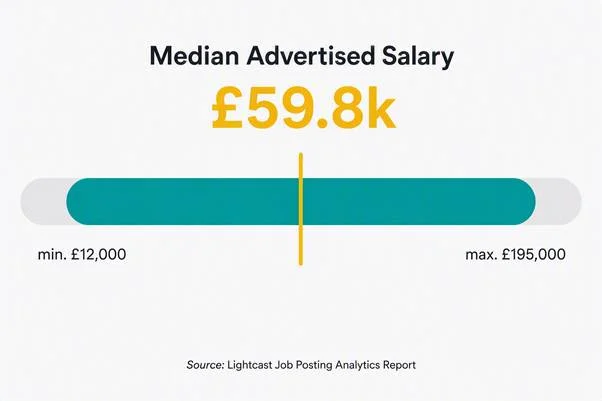
According to the Lightcast Job Posting Analytics Report, the median advertised Finance Business Partner salary was £59,840.11
Salary data benefits from a little context. The Lightcast Job Posting Analytics Report identified 4,083 of 9,495 matching Finance Business Partner job postings, giving salary visibility for 43% of the vacancies analysed.11
Almost half of the salary-disclosing vacancies, advertised salaries of £60,000 or more, while approximately 32% offered at least £66,000.11
The data also shows that:11
- 49% of advertised salaries fell between £48,000 and £65,999
- 23% advertised salaries of £72,000 or more
- 11% were within the highest band of £84,000 to £195,000
- 20% advertised salaries below £48,000
The broad salary range is likely to include roles with different levels of seniority, responsibility and commercial scope. Location, sector and employer size may also influence the salary attached to an individual opportunity.
The £59,840 median11 offers a practical reference point when benchmarking your next move. However, it is worth considering the role’s responsibilities, progression potential and wider benefits alongside the advertised salary.
As 57% of matching job postings did not include salary information, these figures reflect salary-disclosing vacancies rather than the entire Finance Business Partner market.11
What salary and benefits should Finance Business Partners look for?
Base salary matters, but it is only one part of what a role may offer.
The CIPD defines reward as encompassing pay, benefits and non-financial rewards. It notes that effective reward packages balance the needs of employees, the organisation and its wider purpose, culture and performance.12
When comparing opportunities, consider the complete package:
- Employer pension contributions and salary-sacrifice arrangements
- Annual or long-term bonus structures
- Annual leave and additional company holidays
- Private medical cover and other insurance
- Flexible or hybrid working arrangements
- Professional qualification and training support
- Study leave
- Car allowances or other role-specific benefits
- Share schemes, where available
- Opportunities to broaden your responsibilities
- Quality of management and access to senior stakeholders
- The clarity of the progression route
Not every benefit can be given a simple financial value. A stronger pension contribution has a measurable monetary benefit, while supportive leadership, meaningful responsibility and access to strategic decisions may contribute more gradually to your longer-term career.
Flexible working may also form an important part of the overall proposition. The Office for National Statistics found that 28% of working adults in Great Britain hybrid worked between January and March 2025. Hybrid working was more common among people in higher income bands and those with higher qualification levels.13
The useful question is not simply, “How many days can I work from home?” Consider whether the arrangement would give you the right balance of autonomy, collaboration, visibility and access to decision-makers.
A role with a slightly lower base salary may still offer greater overall value if it provides stronger benefits, more useful experience or a clearer route into your next position. Equally, an attractive headline salary should be considered alongside the workload, expectations and development opportunities attached to it.
What skills do employers look for in a Finance Business Partner?
The modern Finance Business Partner needs a combination of technical credibility and commercial influence.
What technical finance skills do Finance Business Partners need?
Your foundations still matter. Strong budgeting, forecasting, management accounting, variance analysis, financial modelling and financial control skills give you credibility when challenging decisions.
How important is commercial awareness for a Finance Business Partner?
The more clearly you understand how the organisation makes money, serves customers and manages costs, the more useful your financial insight becomes.
What stakeholder management and influencing skills are required?
ICAEW specifically identifies influencing, relationship-building and translating data into meaningful insights as important elements of finance business partnering.2
You do not need to become the loudest person in the room. You do need to be able to explain complex information clearly, listen carefully and challenge constructively.
What digital and data skills do employers expect?
Confidence with Excel remains useful, but finance professionals increasingly need to work comfortably with financial systems, dashboards, data visualisation and automation.
CIMA highlights critical thinking, communication, analysis and problem-solving alongside digital and strategic capabilities.14
Do Finance Business Partners need AI skills?
You do not necessarily need to build AI tools yourself. Understanding how AI can support forecasting, analysis, reporting and repetitive tasks is becoming increasingly relevant.
The World Economic Forum's Future of Jobs Report 2025 identifies AI and big data as the fastest-growing skills in importance over the next five years, alongside technological literacy, analytical thinking, creative thinking and leadership and social influence.15
ACCA's 2026 Global Talent Trends research found that 82% of finance professionals surveyed felt confident in their ability to learn and apply AI capabilities, while 51% remained concerned about the potential impact of AI on their jobs.16
The message is less about competing with technology and more about learning how to use it thoughtfully.
How can you increase your value as a Finance Business Partner?
Your value as a Finance Business Partner is shaped not only by your technical knowledge, but by how effectively you turn financial information into commercial action. Building closer operational relationships, developing stronger data skills and demonstrating measurable outcomes can help you become a more influential partner and prepare for your next career move.
How can Finance Business Partners demonstrate commercial impact?
Instead of simply listing responsibilities on your CV, explain the decisions you supported and the outcomes you helped achieve.
For example, consider the difference between “responsible for forecasting” and explaining how you improved forecast visibility, supported a cost decision or helped a leadership team understand a material variance.
How can Finance Business Partners improve operational knowledge?
Spend time with the teams your numbers describe. Understand their customers, processes, cost drivers and pressures.
The closer your financial analysis is to the reality of the operation, the more useful your recommendations become.
How can Finance Business Partners become more data-driven?
Look beyond producing spreadsheets. Learn how to build clear dashboards, interrogate data and communicate patterns visually.
If your organisation is introducing new systems or AI tools, volunteering to understand their finance applications can also broaden your experience.
How can Finance Business Partners improve stakeholder influence?
A Finance Business Partner often needs to challenge someone who does not report to them.
Work on asking better questions, presenting alternatives and understanding the perspective of the person making the decision.
How can Finance Business Partners accelerate career progression?
Professional qualifications such as ACA, ACCA and CIMA can provide an important technical foundation. But development does not stop when the qualification is complete.
Keep a record of new systems, projects, commercial decisions, transformation work and leadership experiences. These examples can become some of the strongest evidence of progression when you begin exploring your next role.
What career mistakes can limit Finance Business Partner progression?
Career progression is not always about fixing a weakness. Sometimes it is about making sure the value you already bring is visible.
A few habits are worth reconsidering.
- Staying too close to the reporting cycle. Accurate reporting matters but try to make time for the questions that sit beyond the monthly pack.
- Waiting for someone else to define your development. Your manager can help, but you can also identify the experiences you want next and look for projects that provide them.
- Undervaluing communication. Strong technical knowledge is powerful, but it has less impact if stakeholders cannot understand what you are recommending or why it matters.
- Treating technology as someone else's responsibility. You do not need to become an IT specialist. You do need enough curiosity to understand how changing technology affects finance processes and decisions.
- Focusing only on title and salary. Both matter, but a role that gives you ownership of a larger commercial area, exposure to senior stakeholders or experience in a new sector may also materially change your future options.
Will AI replace Finance Business Partners?
AI is likely to change the work rather than simply remove it.
The Bank of England's 2026 analysis found that businesses are already using AI to automate routine tasks and accelerate knowledge-based work, including in finance and administrative functions. It also noted that productivity improvements vary significantly according to how effectively AI is implemented and the level of human oversight.17
ACCA and CA ANZ similarly argue that finance needs to evolve from a retrospective reporting function towards a strategic provider of trusted insight.5
For Finance Business Partners, this points towards a useful distinction.
If technology can produce a report more quickly, your value may increasingly lie in interpreting it. If AI can identify a variance, your role may be to understand its commercial significance. If automation can produce an initial forecast, you may need to challenge its assumptions and explain the implications to decision-makers.
Human judgement remains important because financial decisions involve context, risk, priorities and competing objectives that cannot always be reduced to a dataset.
Key takeaways for your Finance Business Partners Career
The Finance Business Partner role continues to sit close to important business decisions, but the nature of the work is evolving.
The strongest career foundations are likely to remain:
- Sound technical finance expertise
- Commercial and operational understanding
- Clear communication and stakeholder influence
- Confidence with data and digital tools
- Curiosity about AI and automation
- The ability to turn analysis into practical insight
- Evidence of supporting meaningful business decisions
Salary is worth benchmarking, but the right next move is about more than a number. Consider the experience you will gain, the people you will work with, the decisions you will influence and the skills you will develop.
Looking for your next Finance Business Partner role?
If you are ready to explore what could come next, take a look at Tate's current finance jobs or you can also register with Tate’s talent network, let us know what your ideal next role looks like, to stay connected and make sure you're first in line when the right opportunity comes up.
A career move does not always need to happen immediately. Sometimes the most useful first step is simply understanding what your experience is worth, which skills are opening doors and what kind of role could give you the experience you want next.
References
- Office for National Statistics, Vacancies and jobs in the UK: July 2026.
- ICAEW, Finance business partnering: five skills you need, 2025.
- CIMA, Upward mobility as a Finance Business Partner.
- Bank of England, Agents' summary of business conditions: September 2026.
- ACCA and CA ANZ, Bridging skills and data gaps for AI-enabled finance, 2026.
- Bank of England, Monetary Policy Report, February 2026.
- Bank of England and Financial Conduct Authority, Artificial intelligence in UK financial services, 2024. https://www.bankofengland.co.uk/report/2024/artificial-intelligence-in-uk-financial-services-2024
- UK Finance, Monthly Economic Review, September 2026. https://www.ukfinance.org.uk/data-and-research/economic-insight/monthly-economic-review-september-2026
- Make UK, Manufacturing Outlook 2026 Q2. https://www.makeuk.org/insights/reports/manufacturing-outlook-2026-q2
- NHS England, NHS finance business rules from 2026/27: guidance for integrated care boards and NHS trusts. https://www.england.nhs.uk/long-read/nhs-finance-business-rules-from-2026-27-guidance-for-integrated-care-boards-and-nhs-trusts/
- Lightcast, Job Posting Analytics Report.
- CIPD, Reward: An introduction, 2025. https://www.cipd.org/uk/knowledge/factsheets/reward-factsheet/
- Office for National Statistics, Who has access to hybrid work in Great Britain?, 2025. https://www.ons.gov.uk/employmentandlabourmarket/peopleinwork/employmentandemployeetypes/articles/whohasaccesstohybridworkingreatbritain/2025-06-11
- CIMA, The skills that set finance professionals apart, 2026.
- World Economic Forum, Future of Jobs Report 2025.
- ACCA, Global Talent Trends 2026.
- Bank of England, Agents' summary of business conditions: July 2026.