


Finance Managers play an important role in helping organisations understand performance, manage change and make well-informed decisions. While strong technical accounting skills remain essential, the role is becoming broader, more commercially focused and increasingly connected to technology.
According to Skills England and HM Treasury’s financial services skills assessment, employment across ten priority financial services occupations is projected to grow by 130,000 roles, or 22.5%, between 2025 and 2035. When the need to replace people leaving these occupations is included, total demand could reach approximately 315,000 workers. The assessment also highlights the growing importance of numeracy, digital literacy, financial analysis and budget forecasting. [1]
For Finance Managers thinking about their next step, the message is clear: technical expertise continues to matter, but commercial judgement, communication and digital confidence are becoming equally important.
What is Changing for Finance Managers?
The Finance Manager role is moving beyond reporting and financial control.
Organisations increasingly need Finance Managers who can:
- Interpret financial information and explain what it means for the business
- Support growth, change and transformation
- Work closely with commercial and operational teams
- Identify ways to improve performance
- Use technology and automation confidently
- Help senior leaders make informed decisions
As more routine finance activities become automated, human capabilities such as judgement, curiosity, communication and influence are likely to become even more valuable.
Which Sectors Offer Attractive Opportunities for Finance Managers?
The right sector will depend on your experience, interests and career priorities. However, several areas offer particularly relevant opportunities for Finance Managers looking to develop broader commercial, digital or strategic experience.
Financial Services
Financial services is one of the UK’s priority growth sectors. Organisations across banking, insurance, wealth management and specialist finance are continuing to respond to technological change and the growing use of data and AI.
The sector can offer Finance Managers exposure to:
- Complex commercial decisions
- Financial governance and risk
- Digital transformation
- Data-led decision-making
- Broader finance leadership responsibilities
Skills England identifies digital literacy, data analysis and forecasting among the important capabilities required across priority financial services occupations.1 2
Technology and Software
Technology businesses can be an attractive option for Finance Managers who enjoy working in fast-changing, commercially focused environments.
Depending on the organisation, opportunities may include exposure to:
- Growth forecasting
- Investment analysis
- Subscription and recurring revenue models
- Business scaling
- Commercial business partnering
- Technology-enabled finance transformation
ACCA’s digital finance learning resources reflect the growing relevance of data analytics, AI, automation, fintech and digital strategy to modern finance careers.3 4
Renewable Energy and Infrastructure
Renewable energy and infrastructure environments may suit Finance Managers who are interested in long-term investment, major projects and financial planning.
Relevant experience can include:
- Capital expenditure analysis
- Investment appraisal
- Long-term forecasting
- Risk management
- Project governance
These roles can help Finance Managers develop their understanding of complex investments and long-term financial decision-making.
Healthcare and Life Sciences
Healthcare and life sciences organisations operate in environments where financial planning, governance and regulatory awareness are especially important.
Finance Managers working in these sectors may develop experience in:
- Financial governance
- Budget management
- Regulatory requirements
- Commercial forecasting
- Investment and resource planning
Advanced Manufacturing
Manufacturing offers opportunities for Finance Managers who want to work closely with operations and understand how financial performance connects with production, cost and supply chains.
Relevant capabilities can include:
- Cost management
- Operational finance
- Performance analysis
- Supply chain finance
- Productivity improvement
- Business partnering
What is the median Finance Manager salary in the UK?
Salary is likely to be an important consideration when you are benchmarking your current position or assessing a new role.
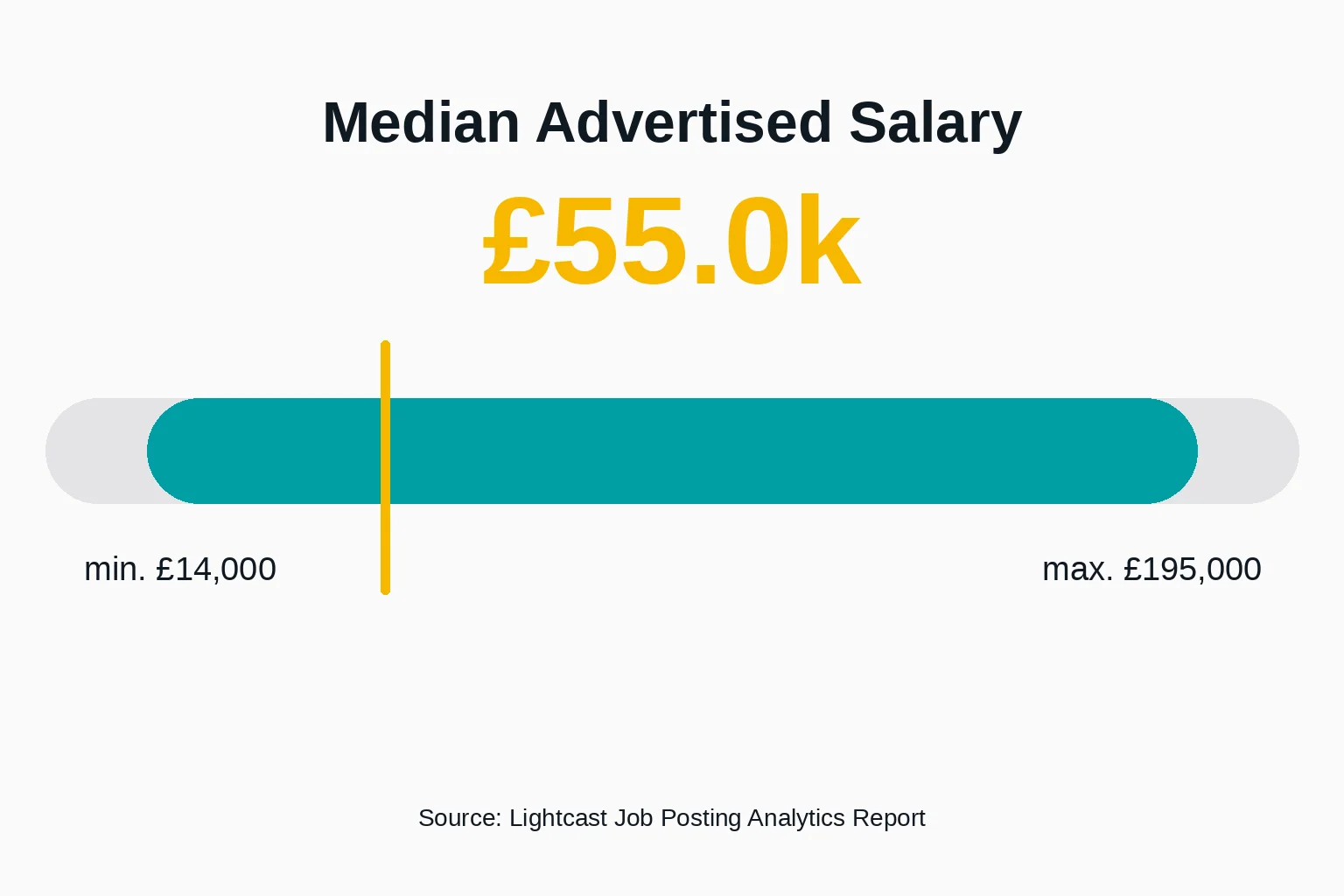
According to Lightcast Job Posting Analytics Report, the median advertised Finance Manager salary was £54,976.5
Salary information was available for 6,174 of the 12,024 matching job postings, giving salary visibility for 51% of the vacancies analysed.
Among the postings that disclosed pay:
- 54% advertised salaries of £55,000 or more
- 32% advertised at least £60,500
- 20% advertised £66,000 or more
- 13% advertised at least £71,500
- 9% fell within the broadest and highest band of £77,000 to £195,000
Just over half of the advertised salaries, 52%, were between £44,000 and £60,499. A further 17% advertised salaries below £44,000.
The overall range extended from £14,000 to £195,000. This considerable spread is likely to contain roles with very different levels of seniority, responsibility and commercial influence. However, the supplied data does not isolate the effects of location, sector, employer size, working hours or qualification status. The highest band is also particularly broad, so it should not be interpreted as a typical salary range for the role.
The £54,976 median offers a useful reference point rather than a definitive valuation of your experience. A role involving a large team, complex reporting, transformation or significant commercial responsibility may carry different expectations from a position with a more narrowly defined remit.
There is also an important limitation to keep in mind. As 49% of matching job postings did not disclose salary information, the findings represent salary-transparent vacancies rather than the whole UK Finance Manager market.
When comparing opportunities, consider the scope of the role, leadership exposure, progression potential and complete reward package alongside the advertised salary.
When comparing opportunities, look beyond the headline salary and consider:
- The actual scope of the role
- Bonus structure and performance measures
- Pension contributions
- Flexible or hybrid working arrangements
- Professional development support
- Leadership exposure
- Opportunities to develop commercially valuable experience
A role offering a slightly lower salary may still represent the stronger career move if it provides broader responsibility, meaningful development and a clear opportunity to grow.
What should you consider beyond a Finance Manager’s base salary?
A good opportunity should work for your career and your life.
Depending on your priorities, a competitive overall package may include:
- Hybrid or flexible working
- Enhanced pension contributions
- Private healthcare
- Additional annual leave
- Professional qualification support
- Leadership development
- Internal career opportunities
- Wellbeing and mental health support
Benefits should not be assessed in isolation. It is worth considering how the complete package supports your financial goals, personal circumstances and longer-term ambitions.
Which skills are most valuable for Finance Managers?
1. Data Analytics
Finance Managers are increasingly expected to turn data into useful insight.
This can include:
- Forecasting
- Scenario modelling
- Trend analysis
- Dashboard reporting
- Identifying risks and opportunities
ACCA describes data analytics and other digital capabilities as important for finance professionals looking to improve processes, generate deeper insight and contribute strategically. 4 5
The technology matters, but so does the ability to ask the right questions and explain the findings clearly.
2. AI Literacy
Finance Managers do not need to become AI specialists, but a practical understanding of AI is becoming increasingly useful.
This includes knowing:
- Where AI and automation may improve efficiency
- Where human review and judgement remain essential
- How data quality affects outputs
- What governance, privacy and security issues need consideration
- How emerging tools can support rather than replace decision-making
ACCA identifies digital agility and an understanding of the ethical implications of data and AI as relevant capabilities for finance professionals. 3 6
3. Data Visualisation
Even strong financial analysis can lose its value if decision-makers cannot understand it.
Finance Managers who can present complicated information clearly can make it easier for colleagues to identify priorities and act with confidence. This may involve dashboards, visual reporting and other tools that help translate financial data into an accessible business story.
ACCA’s digital capability framework includes using technology to analyse, interpret, evaluate and communicate data in support of decision-making. 6
4. Business Partnering
Modern Finance Managers often work closely with people outside the finance function.
Effective business partnering involves:
- Listening carefully to operational priorities
- Challenging assumptions constructively
- Explaining financial implications clearly
- Building trusted relationships
- Turning analysis into practical recommendations
It is not simply about presenting numbers. It is about helping colleagues understand their options and make better decisions.
5. Digital Finance Capability
Digital confidence is becoming a core part of the Finance Manager skill set.
Useful areas of knowledge include:
- Finance automation
- Data governance
- Cybersecurity awareness
- Digital finance systems
- Responsible AI use
- Process improvement
ACCA highlights AI, automation, data analytics, cybersecurity and fintech within its digital and data learning for finance professionals. 3 4
Five Ways to Strengthen Your Value as a Finance Manager
Look Beyond the Report
Accurate reporting will always matter, but the real value often comes from explaining what the figures mean.
Try to connect financial performance with:
- Customer activity
- Operational performance
- Revenue and margin
- Investment decisions
- Business risks
- Future priorities
Build Your Commercial Understanding
Take time to understand how your organisation makes money, where costs arise and what influences profitability.
The more confidently you can connect financial information with business performance, the more useful your contribution becomes.
Develop Your Technology Skills
You do not need to master every new platform. Focus on the tools and capabilities that can make your work more insightful, efficient and useful.
This may include:
- Data analytics
- Dashboard reporting
- Automation
- AI-assisted analysis
- Finance systems
- Data governance
Gain Experience of Change
Experience of change can broaden your perspective and demonstrate that you can contribute beyond established finance processes.
Useful opportunities may include:
- Systems implementations
- Process improvement projects
- Automation initiatives
- Finance transformation
- Restructuring or integration activity
Invest in Relationships
Strong Finance Managers make complicated information easier to understand and create space for constructive challenge.
Building trusted relationships across a business can help you influence decisions, understand operational pressures and contribute earlier to important conversations.
Common Career Habits That Can Limit Progression
Career development is rarely about one perfect move. It is often shaped by the experience you build gradually and the opportunities you choose to pursue.
Some Finance Managers may find their progression slowing if they:
- Remain focused only on reporting and control
- Have limited exposure to commercial decision-making
- Avoid unfamiliar systems or technology
- Struggle to communicate with non-finance audiences
- Wait for broader responsibility rather than seeking it
- Build deep technical expertise without developing leadership or influence
- Focus on job title without considering the quality of the experience offered
None of these is irreversible. Small, deliberate steps can make a meaningful difference, whether that means joining a transformation project, working more closely with an operational team or becoming more confident when presenting recommendations.
How AI and Automation Could Shape the Finance Manager Role
AI and automation are changing how some finance activities are completed, but that does not remove the need for experienced Finance Managers.
Instead, the emphasis is shifting towards work that requires:
- Interpretation
- Judgement
- Communication
- Commercial awareness
- Governance
- Strategic thinking
- Leadership through change
Skills England notes that there is considerable uncertainty around the effect of AI on future employment demand. Its assessment nevertheless identifies digital literacy, data analysis and forecasting as important capabilities within priority financial services occupations.1
For Finance Managers, the opportunity is to use technology to reduce avoidable manual work and create more time for analysis, collaboration and forward-looking advice.
Key Takeaways for Finance Managers
- Technical accounting remains fundamental, but it is no longer the whole role.
- Commercial judgement, data confidence and stakeholder influence are becoming increasingly valuable.
- Financial services, technology, renewable energy, healthcare and advanced manufacturing can offer opportunities to develop broader experience.
- Salary is important, but role scope, flexibility, development and leadership exposure also affect the overall value of an opportunity.
- AI and automation are changing finance work, making interpretation, governance and human judgement more important.
- The strongest career moves are often those that add meaningful experience, not simply a more senior title.
Thinking About Your Next Finance Role?
If you are ready to explore what could come next, take a look at Tate’s current finance jobs or register with Tate’s talent network let us know what your ideal next role looks like, to stay connected and make sure you're first in line when the right opportunity comes up.
You do not need to have your entire career mapped out. A useful next move may simply be one that gives you stronger systems experience, broader responsibility or a clearer route towards the area of finance that interests you.
References
- Skills England (2026). Sector Skills Needs Assessment: Financial Services. GOV.UK. https://www.gov.uk/government/publications/skills-england-annual-skills-report-and-sectoral-skills-needs-assessments-2026/sector-skills-needs-assessment-financial-services
- Skills England and HM Treasury (2026). Financial Services Sector Skills Needs Assessment (PDF). https://assets.publishing.service.gov.uk/media/6a18581f65bc5f798327f4c3/sna_financial_services.pdf
- ACCA. Certificate in Digital Finance Essentials: Overview. https://www.accaglobal.com/gb/en/qualifications/glance/certificate-in-digital-finance-essentials/overview.html
- ACCA. Digital and Data Finance Courses (ACCA Learning). https://www.accaglobal.com/gb/en/qualifications/acca-learning/courses-digital-data-finance.html
- Lightcast. Job Posting Analytics Report: Finance Manager.
- ACCA. Career Navigator: Digital capabilities (Proficient). https://careernavigator.accaglobal.com/gb/en/journey/capabilities/digital/Proficient.html


